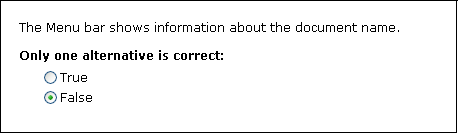
The tests include various types of questions. Some of the questions have illustrations which are displayed below the question. The simplest question type has two answer alternatives, see the illustration below. Here you must decide whether a statement is True or False.
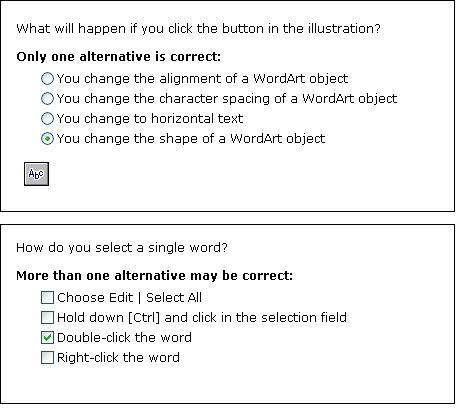
Other types of questions can include multiple choice questions where either one or several of the answers are correct, see the illustrations below. If only one option is correct, radio buttons are used. If several options can be correct, check boxes are used.
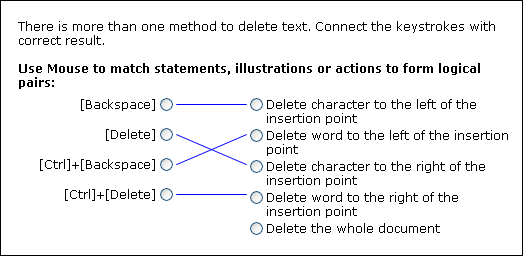
In combination questions (matching items) you will connect one of the answer options in the left-hand column with the correct alternative in the right-hand column, see the illustration below.
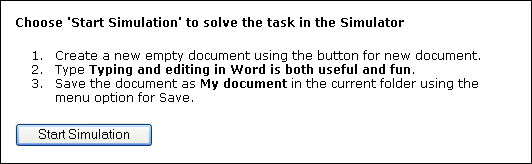
Tests designed from 2003 can also contain simulation questions, see the illustration below. When starting the exercise, a simulator is displayed in a separate window. The exercise will be solved in the simulator, which has approximately the same functionality as the real application. If you do the exercise several times, the latest answer becomes valid.
Normally one point is given for each correct answer. Combination questions and questions with several correct answer alternatives can therefore give more points than those with two answer alternatives. In simulation exercises, usually one to three points is given for each step in the exercise.
See also:
Running a test
Test results